
AMH Testing, Without the Fear
The Truth About AMH Testing - What the "egg timer" test can and cannot tell you, and who it is really for.
At Sydney Women’s Wellness we believe knowledge is power in every aspect of women’s health, and fertility is no exception. Understanding your own fertility, early and clearly, is one of the most empowering things you can do, because it lets you plan and choose from a place of information rather than guesswork.
Which is why it pains us a little to see what the AMH test has become in the wrong hands. We regularly meet women who arrive holding an AMH result in their hand and a knot of worry in their stomach. Some ordered the test online. Others had it done by a doctor but without the explanation of what it would, and would not, mean.
Almost always, that fear is built on a misunderstanding of what the test actually can show. So we would love to gently set the record straight, because AMH is a useful and empowering test, but it is simply only as good as the conversation around it. Used well, for the right person and the right reason, it gives real, useful information that helps you take charge of your fertility. The whole difference lies in knowing what it can and cannot tell you, and who it is, and isn't, for.
What AMH actually measures
AMH, or anti-Müllerian hormone, is made by the small follicles in your ovaries. Measuring it gives a reasonable estimate of your ovarian reserve, which is roughly how many eggs you have remaining. It is an estimate of how many eggs, at that point in time. Not how good they are. Not when they will run out. Just, broadly, how many.
Quantity is not quality
This is the single most important thing to understand, and the part the marketing tends to skip. AMH reflects the quantity of your eggs, not their quality. And egg quality, which is what most determines whether an egg can become a healthy pregnancy, is mostly driven by your age.
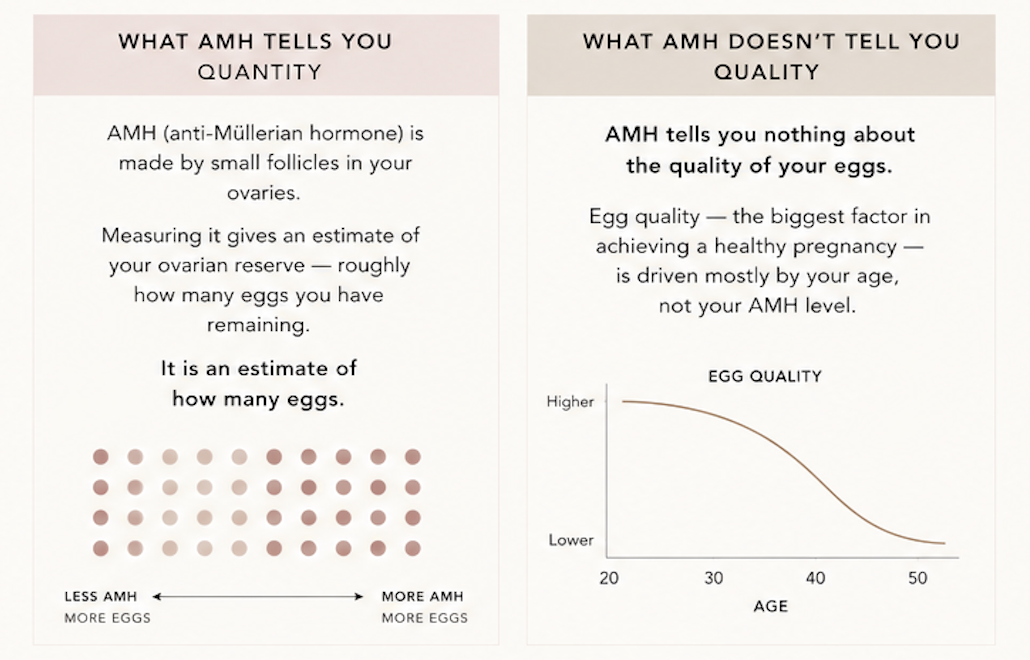
This is one of the reasons AMH is not a good tool for deciding when to have a baby, particularly once you are past 35. By then, egg quality is the factor that matters most, and AMH says nothing about it. Two women can share the exact same AMH result, but if one is 29 and the other 39, their egg quality, and their chances of conceiving and carrying a healthy pregnancy to term, can be very different. A reassuring number cannot turn back that clock, and it should never be read as a reason to wait.
A number, not a verdict
There is real value in knowing your ovarian reserve. We just want you to know the two things AMH cannot do, however confidently it is sold.
It cannot tell you whether you will conceive naturally. In women with no history of infertility, a low AMH has not been shown to meaningfully reduce the chance of conceiving. Many women with a low result go on to fall pregnant with no help at all. A low number is not a closed door.
And it cannot tell you when you will reach menopause. AMH does fall as menopause approaches, but it cannot reliably predict the timing for an individual. It holds promise in this space, but it is not yet a validated way to pick up early menopause or premature ovarian insufficiency.
“A single number on a blood test cannot tell you whether you will have a baby, or when your fertility will end. Knowing it is still useful, as long as you know what it is, and what it isn't.”
A snapshot, not a verdict
There is one more thing worth knowing, because it surprises people. AMH is often treated like a permanent fact about you, in the way your height is. It is closer to a snapshot, and that snapshot can move.
Helpfully, AMH stays relatively steady across your menstrual cycle, so unlike some hormone tests it does not need to be done on a particular day. But it can still drift from month to month, and several things can nudge the number. The most important is hormonal contraception. The pill suppresses your ovaries, so a test taken while you are on it often comes back lower than your true level. Reassuringly, there is no evidence the pill harms your fertility, and your AMH returns to its usual range once you stop. For a true baseline, we often suggest testing off hormonal contraception, allowing a few months for your own pattern to settle. Body weight, vitamin D levels, high doses of biotin supplements, and even the particular laboratory assay used can shift the result too. All of which is to say: the number means very little on its own, and its always important to interpret it with clinical advice.
Where AMH earns its place
In the right hands, for the right reasons, AMH is an incredibly empowering tool.
It helps your specialist plan IVF or other fertility treatment, by guiding how your ovaries are likely to respond so your care and medication can be tailored. It is valuable before egg freezing or fertility preservation, to set realistic expectations about how many eggs might be collected. It now forms part of the assessment for PMOS (formerly - polycystic ovary syndrome): the 2023 international guideline added serum AMH as an alternative to ultrasound for identifying polycystic ovaries in adults.
It is also worth considering if you may be at higher risk of a reduced egg supply or earlier menopause. Surgery for endometriosis or ovarian cysts can lower ovarian reserve, and chemotherapy can cause a significant drop. For women in these situations, or with certain autoimmune conditions such as coeliac disease, or a family history of early menopause, knowing your ovarian reserve early can help you and your doctor decide whether fertility preservation, such as egg freezing, is worth thinking about sooner rather than later.
Who it is for, and what to know first
Here is where we like to be honest with our patients. For most women interested in knowing their AMH can be helpful, but it can also be harmful, so being informed with the right information at the right time is crucial.
So a couple of gentle notes on timing. AMH is unlikely to help you right now if you are already trying to conceive and it is early days, since AMH can’t tell you your chances of falling pregnant this cycle, next cycle or even in 6 months time. So if you are about to, or already trying to conceive, the usual advice is to keep trying and to investigate only if you have not conceived after twelve months, or after six months if you are over 35.
The other situation where we would not reach for an AMH is when you are hoping a good result will reassure you that it is safe to delay starting a family. A healthy AMH for your age is reassuring about egg numbers, but it cannot speak to egg quality, and leaning on a high result to guide your timing can give you a false sense of security. Fertility declines with age regardless of what your AMH shows. So if you are not in a position to start a family right now, whether by choice or by circumstance, but your age is advancing, the most useful step is a review with a GP or fertility specialist. Together you can look at the fuller picture, talk honestly about your timeline, and weigh up whether options like egg freezing are worth considering while you still have the most choice.
For all the women who would prefer not to know, as they are unsure whether options like egg freezing or donor conception would ever be for you, that uncertainty is a reason to have the conversation, not to avoid it. Understanding where your fertility stands now means every option can be weighed properly, with facts, not what ifs, while you still have the most choice, so that your future options are protected rather than quietly lost to time.
A word on "boosting" your AMH
While we are here, one myth worth retiring. There is no proven way to raise your AMH. It reflects the follicles you already have, and no supplement, tea or twelve-week protocol can grow you more eggs, whatever the label promises. So if a product claims to boost your ovarian reserve, that is your cue to scroll on and keep your money.
This matters more than it first appears. These products are sold in the language of empowerment, but they often do the opposite. A woman who pins her hopes on a fertility supplement can lose the one thing she cannot get back: time. Months or years spent chasing a result that was never possible are months or years she might have spent taking a step that actually protects her fertility. Because the only thing that reliably holds your eggs at their current age is freezing them, which is a real medical option, not a wellness purchase. We would always rather you spent that precious time on a conversation that counts.
AMH is one piece of a much bigger picture
It is also worth remembering that AMH is a single piece of the fertility puzzle. Your age, the regularity of your cycles, your general health, your medical history and your family history, the condition of your uterus and fallopian tubes, and, if there is a partner involved, their fertility too, all matter at least as much.
Which is why the real answer is a conversation, not just a blood test.
If you are thinking about your fertility, the most powerful step is not a number bought online after a deep dive on google. It is a proper fertility review or preconception consultation with a GP, and it gives you far more than AMH ever could.
A preconception consult is where the bigger picture comes together. It is a chance to look at your cycle and your general health, to review any medications and check your immunity, to make sure things like your folate, iodine, iron, thyroid and cervical screening are where they should be, and to talk through timing and goals honestly. It is also when genetic carrier screening can be offered, and when AMH or an ultrasound can be added if, and only if, they will inform and empower. If there is a male partner, don’t forget their health is part of the conversation too, as it take two to tango!
Whether you are hoping to conceive soon, weighing up whether you can wait, or simply want to understand your fertility better, that fuller assessment gives you something a single AMH result never can: a plan that fits your life and protects your options. Knowledge really is power. It is at its most powerful when it is complete, and when someone is in your corner helping you read it.
If you would like that fuller picture, our GPs offer preconception and fertility consultations designed for exactly this.
For further reading
Monash IVF, AMH Blood Test — a clear, clinically reviewed explainer of how AMH is used in fertility planning and treatment, from the service you refer to: https://monashivf.com/services/early-intervention/amh-blood-test/
The Conversation, "Don't believe the hype: egg timer tests can't reliably predict your chance of conceiving or menopause timing" — an independent, evidence-based piece by University of Queensland researchers that backs up the core of this article: https://theconversation.com/dont-believe-the-hype-egg-timer-tests-cant-reliably-predict-your-chance-of-conceiving-or-menopause-timing-207008
Your Fertility — the national, government-funded fertility education program, excellent independent reading on AMH, age and preconception health: https://www.yourfertility.org.au